
OFFSHORING2PH INSIGHTS
Beyond Cost Savings: Building Stronger SMEs with Offshore Virtual
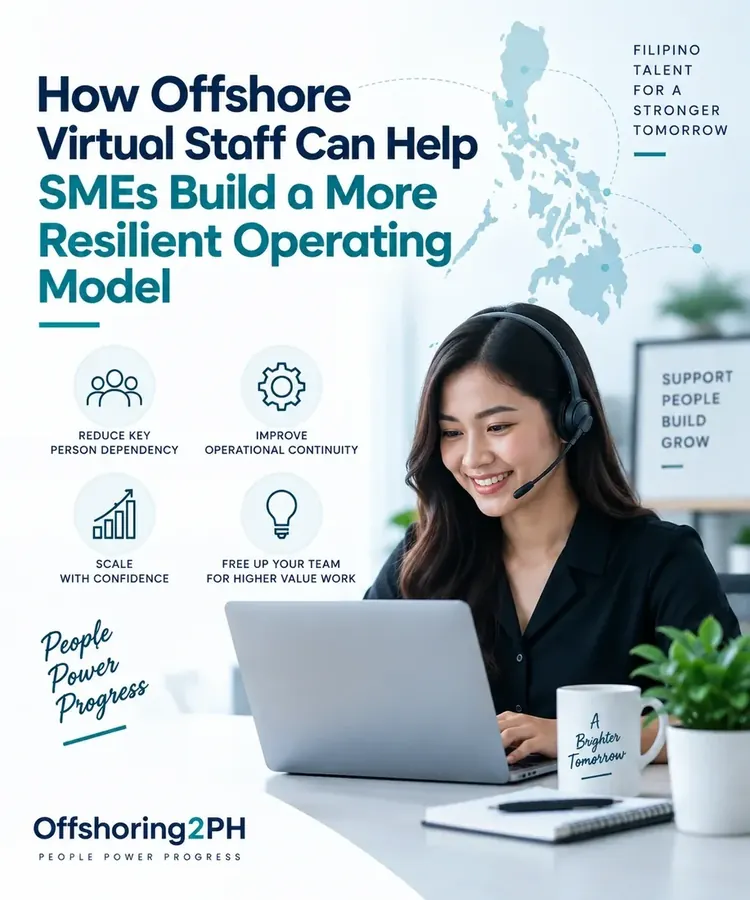
For growing companies, offshore outsourcing is most valuable when it reduces single-person dependency, protects management capacity, and creates repeatable workflows that can scale.
September 14, 2026 | Offshore Staffing Strategy
Resilience is becoming a staffing question
For years, offshore outsourcing was often discussed primarily as a cost strategy. Lower operating costs still matter, particularly to small and medium enterprises and startups working with limited capital. But the more durable argument for offshore virtual staffing is broader: it can help a growing business become less dependent on a handful of overloaded people.
In many SMEs, critical work accumulates around founders and senior employees. One person knows how the customer database is maintained. Another prepares every recurring report. The founder still handles scheduling, approvals, follow-ups, and administrative exceptions. When those people become unavailable or simply run out of capacity, work slows quickly.
A thoughtfully designed offshore role can help distribute that operational load. The objective is not merely to move tasks to a lower-cost location. It is to create clearer ownership, better documentation, and enough capacity for the business to continue operating without every routine process depending on its most expensive people.
The real risk of a lean team is concentration
Lean teams can move quickly, but they can also concentrate too much knowledge and responsibility in too few hands. That creates what operators sometimes call key-person dependency: a process works because a particular employee remembers how to do it, not because the business has built a reliable system.
This problem is common in startups because speed comes before structure. It is also common in established SMEs where processes have evolved informally over many years.
Offshore staffing can provide a practical reason to change that. Before a virtual staff member can own a recurring responsibility, the company must clarify the workflow, tools, expected output, deadlines, and escalation points. Delegation therefore becomes an opportunity to turn informal knowledge into an operating process.
Use offshore staff to create ownership, not just assistance
The weakest outsourcing model is a permanent queue of miscellaneous tasks. The employee waits for instructions, management continually decides what to delegate, and neither side develops meaningful ownership.
A stronger model gives the virtual staff member responsibility for a defined business function or recurring outcome. An administrative professional might own calendar coordination and meeting preparation. A sales support specialist might maintain CRM accuracy and prepare prospect research. A customer service representative might manage first-line inquiries under documented escalation rules. A finance support professional might prepare agreed bookkeeping schedules and supporting data for review.
Clear ownership reduces the amount of management energy required to keep work moving. It also gives the employee a better basis for improving the process over time.
Create redundancy without duplicating entire departments
Resilience does not require every SME to maintain two people for every position. It does require businesses to avoid unnecessary single points of failure.
An offshore team member can become part of a deliberate coverage model. For example, routine customer administration can be documented and shared between a local account manager and an offshore support professional. Reporting processes can be standardized so another trained person can prepare them when necessary. Lead-generation workflows can be stored in shared systems instead of living in one salesperson’s personal notes.
The aim is not duplication for its own sake. It is continuity: important recurring work should remain understandable and transferable even when responsibilities change.
Protect senior capacity before it becomes a crisis
One of the clearest signals that a business needs additional support is when senior employees consistently perform work below the level of judgment they were hired to provide.
A founder spending several hours each week formatting reports is not saving the cost of an employee; the company is consuming founder capacity. A sales director cleaning contact records is not avoiding overhead; the business is exchanging selling and coaching time for database administration.
Offshore virtual staffing can improve this equation when recurring work is substantial enough to transfer. The financial benefit should therefore be considered alongside the value of recovered leadership and specialist time.
Standardize the work before adding more people
Adding staff to a confused process usually creates a larger confused process. Before expanding an offshore team, define the operating basics.
For each recurring responsibility, establish the desired outcome, source information, workflow, quality standard, completion frequency, owner, reviewer, and escalation rule. Keep documentation practical. A concise checklist, annotated example, or short screen recording may be more useful than a lengthy manual.
The discipline matters because offshore employees cannot rely on informal office cues to fill every gap. Clear processes make remote work easier to manage and, importantly, often improve the same process for local employees.
Build communication around exceptions, not constant supervision
Effective remote management does not require continuous meetings. It requires predictable communication.
During onboarding, frequent check-ins help surface uncertainty quickly. As the employee becomes proficient, the rhythm can shift toward outcome reviews, priority changes, exceptions, and process improvements. Shared task systems, documented handoffs, and agreed response expectations reduce the need for repeated status requests.
The goal is to create visibility without turning management into surveillance. A virtual staff member who understands the objective, has access to the right information, and knows when to escalate should gradually require less day-to-day direction.
Be realistic about what should stay local or senior
Offshore outsourcing is not appropriate for every responsibility. Work requiring physical presence, highly contextual local relationships, certain regulated activities, or decisions carrying significant legal, financial, or reputational consequences may need to remain with local or senior personnel.
Even when tasks can be delegated, the business remains responsible for appropriate supervision, data protection, access control, quality assurance, and compliance with relevant laws and contractual obligations.
The strongest offshore strategies are selective. They distinguish between work that can be transferred safely and efficiently and work that should remain close to leadership, customers, or licensed professionals.
A resilience test for your current team
A useful exercise is to ask what would happen if each key employee were unavailable for two weeks. Which recurring processes would stop? Which passwords, spreadsheets, customer histories, reports, or routines would be difficult for another person to reconstruct? Which senior employees would immediately absorb the missing work?
Those answers reveal more than staffing gaps. They reveal process risk.
Prioritize responsibilities that are recurring, digitally deliverable, teachable, and important enough that interruptions create real cost. Those are often strong candidates for better documentation and, where appropriate, offshore ownership.
Build capacity that makes the business easier to run
The most useful offshore hire is not necessarily the person who costs the least. It is the person who helps the business operate with greater consistency while allowing higher-value employees to concentrate on the work that genuinely requires them.
Offshoring2PH helps SMEs and startups explore virtual staffing in the Philippines around clearly defined business needs. Whether the pressure point is administration, customer support, sales support, marketing operations, finance support, or another recurring back-office function, the starting point should be the same: identify the work that creates unnecessary dependency and design a role that can own it.
If your business is growing but too much routine work still depends on founders and senior employees, Offshoring2PH can help you evaluate where Filipino virtual staff can add capacity, strengthen continuity, and support a more scalable operating model.