
OFFSHORING2PH INSIGHTS
Beyond Salary: Measuring Offshore ROI
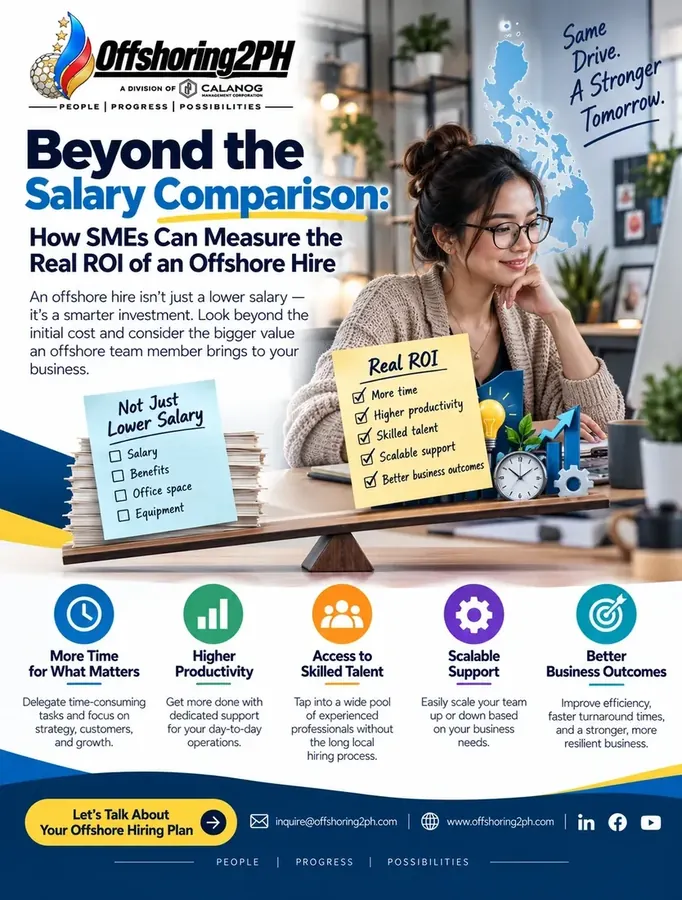
Offshore staffing decisions are often reduced to hourly rates. That is too narrow. For SMEs and startups, the better question is whether a virtual staff role creates measurable capacity, improves execution, and releases higher-value employees to do the work only they can do.
September 30, 2026 | Offshore Staffing Strategy
The cheapest hire is not automatically the best investment
Cost is one of the reasons businesses explore offshore outsourcing, but a salary comparison alone tells management very little about whether a role will create value. A lower employment cost can still be a poor decision if the role is vague, the workload is inconsistent, or managers spend more time correcting work than they recover through delegation.
The reverse is also true. A well-designed offshore role may produce value that is not visible in the wage difference: faster follow-up, cleaner records, more consistent customer support, shorter administrative backlogs, and additional time for senior employees to focus on revenue, clients, analysis, or strategy.
For small and medium enterprises and startups, the useful question is therefore not simply, “How much can we save?” It is, “What business capacity are we buying, and what will that capacity allow us to improve?”
Start with the cost of the work today
Before estimating the return on an offshore hire, establish a baseline. Identify the recurring work the role would absorb and determine who performs it now.
If a founder, sales manager, accountant, or operations lead is spending several hours each week on routine administration, the cost of that work is not zero. The company is already paying for it through senior employee time, delayed priorities, overtime, or work that simply does not get completed.
A practical baseline can include hours spent on the tasks, backlog levels, response times, missed follow-ups, overtime, and the approximate amount of management attention required. The goal is not perfect accounting. It is to understand the operational problem before attaching a staffing solution to it.
Measure capacity released, not just tasks transferred
The strongest offshore roles do more than move tasks from one person to another. They release constrained capacity elsewhere in the business.
Imagine a sales manager who spends eight hours each week researching prospects, maintaining CRM records, preparing meeting information, and organizing follow-ups. If a trained sales-support professional can reliably own much of that workflow, the business has not merely transferred eight hours of administration. It has created additional selling and coaching capacity for the manager.
That distinction matters. The value of the offshore role partly depends on what the local or senior employee does with the time that becomes available. Recovered hours have little strategic value if they are immediately absorbed by more low-priority work.
Use four lenses to evaluate ROI
A useful offshore staffing business case can be reviewed through four lenses: direct cost, capacity, operating performance, and management effort.
Direct cost includes compensation and the other expenses required to support the role, such as software seats, equipment arrangements, recruitment, onboarding, and any provider fees. Capacity looks at the recurring hours or workload transferred from constrained employees. Operating performance considers whether the workflow improves: fewer overdue items, faster response, cleaner data, more consistent reporting, or better service coverage. Management effort accounts for the time required to train, review, communicate, and handle exceptions.
Looking at all four prevents a misleading conclusion based on payroll alone.
Choose metrics that belong to the role
ROI becomes easier to assess when the role has a defined operational purpose. A generic instruction to “help the team” is difficult to measure. A role that owns a specific workflow is much clearer.
For sales support, useful indicators might include CRM completeness, turnaround on prospect research, scheduled next actions, and administrative time recovered by salespeople. For customer support, the business might track response time, backlog, resolution quality, and escalation accuracy. For finance support, measures may include timeliness, reconciliation completion, documentation quality, and the number of review items requiring rework.
Not every metric needs a monetary value. Operational evidence can still show whether the role is making the company easier to run.
Account for the ramp-up period
An offshore hire should not be judged as though full productivity begins on day one. Like any employee, a virtual staff member needs context, systems access, examples, feedback, and time to learn the company’s standards.
During the first several weeks, management effort may temporarily increase. That is normal when the role is properly onboarded. The more useful evaluation point is whether supervision becomes lighter as the employee gains competence and the workflow becomes more stable.
Businesses should therefore separate implementation costs from steady-state performance. A 60- to 90-day review often provides a more realistic picture than evaluating the arrangement after the first few days.
Do not count savings that require lowering the standard
A credible ROI calculation should assume that quality, security, and customer experience remain acceptable. Savings created by skipping controls, undertraining staff, or assigning work beyond an employee’s competence are not sustainable efficiencies.
Role-based access, individual accounts, appropriate multi-factor authentication, documented escalation rules, quality review, and confidentiality practices should be part of the operating model. Regulated or professionally restricted work may require additional safeguards or qualified supervision depending on the industry and jurisdiction.
The purpose of offshore staffing is to improve the allocation of work, not to remove the controls that make the work dependable.
A simple ROI review for the first 90 days
Before hiring, document the workflow, current workload, baseline performance, and the people currently involved. Define what the offshore employee will own and what will remain with managers or specialists.
At approximately 30 days, focus on onboarding quality: access, understanding, communication, and early accuracy. Around 60 days, review whether the employee is taking consistent ownership and whether the original team is beginning to recover time. By 90 days, compare the workflow with the baseline: backlog, turnaround, quality, senior hours recovered, management effort, and total staffing cost.
The business should then make a practical decision. Keep refining the role if the fundamentals are sound, expand responsibilities when performance supports it, or redesign the arrangement if the expected capacity has not materialized.
When the numbers are not enough
Some benefits of a well-designed staffing model are difficult to express in a spreadsheet. A founder who no longer carries every administrative detail may make better use of limited attention. A sales team with reliable support may become more disciplined. A documented workflow may reduce dependence on one employee. Customers may experience a more consistent response.
These outcomes should not be exaggerated or treated as guaranteed. They should, however, be considered alongside direct financial measures because they affect how effectively a growing company operates.
The most useful business case combines hard numbers with observable operating improvements.
Build the role around value, then decide where it should sit
Offshore outsourcing works best when the staffing decision follows the business problem rather than the other way around. First identify the work, the required skill level, the desired outcome, and the management structure. Then determine whether a Philippines-based virtual professional is a suitable way to deliver that capability.
Offshoring2PH helps SMEs and startups evaluate defined support needs and build virtual staffing around real workflows. The goal is not simply to reduce a line item. It is to help businesses place the right work with the right level of talent so existing teams can spend more of their time where they create the most value.
If you are considering an offshore hire, begin with the baseline. When you know what the work costs your business today—in time, delays, management attention, and missed capacity—you can make a far more informed staffing decision.
SEO publishing notes
Suggested meta title: How to Measure the ROI of Offshore Virtual Staff for SMEs
Suggested meta description: Learn how SMEs and startups can evaluate the real ROI of offshore virtual staff using cost, capacity, performance, and management-effort measures.
Primary keyword: ROI of offshore virtual staff
Secondary keywords: offshore staffing ROI, virtual staff Philippines, offshore outsourcing for SMEs, outsourcing for startups, cost of offshore staffing
Suggested URL slug: measure-roi-offshore-virtual-staff-smes