OFFSHORING2PH INSIGHTS
Building More Resilient SMEs with Offshore Staff
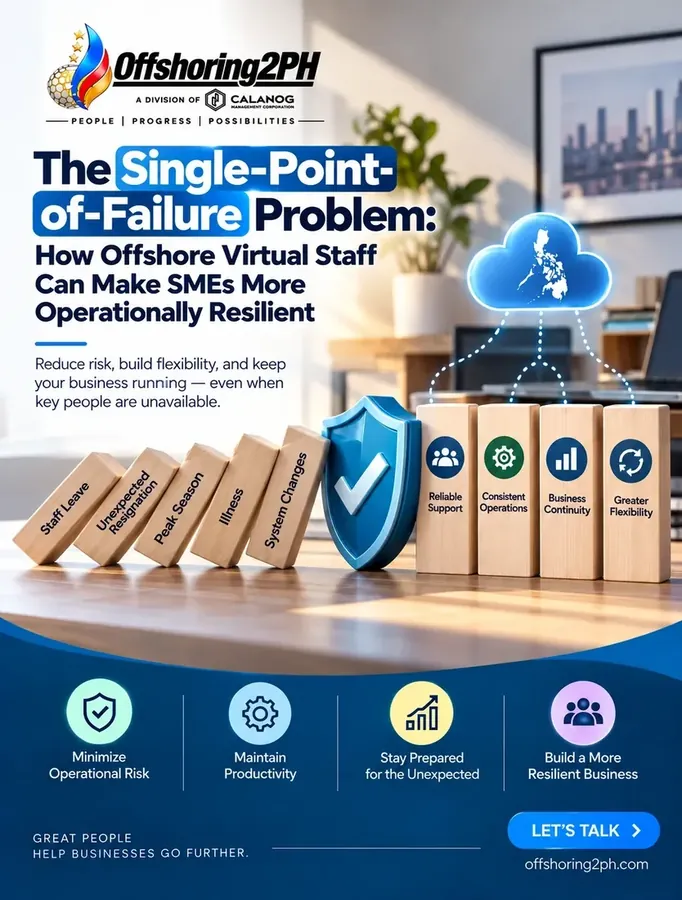
When one employee holds the passwords, process knowledge, customer history, and daily routine for a critical function, a growing business is more fragile than it looks. Thoughtful offshore staffing can help SMEs distribute knowledge, document workflows, and build dependable backup capacity.
October 5, 2026 | Offshore Staffing Strategy
A business can be busy, profitable—and still be fragile
Many small and medium enterprises depend heavily on a handful of capable people. That is often a strength in the early stages of growth. Experienced employees know the customers, understand the exceptions, remember how recurring tasks are handled, and can solve problems quickly without consulting a manual.
The weakness appears when too much of that knowledge lives with one person. A bookkeeper may be the only employee who understands the monthly reporting routine. A sales coordinator may be the only person who knows how leads are categorized and followed up. A founder may hold the history behind every major customer relationship. An operations employee may know the sequence of tasks required to keep a weekly process moving, but none of it is documented.
This is a single point of failure. The business functions well while the key person is available, but an absence, resignation, sudden increase in workload, or competing priority can expose how little operational redundancy actually exists.
Operational resilience is not the same as hiring extra people
Resilience does not mean duplicating every position. For an SME, that would be expensive and unnecessary. It means making sure important workflows can continue when normal conditions change.
That usually requires three things: visible processes, accessible information, and more than one person who understands how critical work moves from start to finish.
Offshore virtual staff can support this structure when the role is designed around defined workflows rather than a random collection of tasks. The offshore employee becomes part of the operating system: maintaining records, following documented procedures, preparing recurring work, and creating a second layer of practical knowledge around the function.
Start by finding your hidden single points of failure
Management teams can begin with a simple question: what work would become difficult tomorrow if one specific employee were unexpectedly unavailable for two weeks?
Look beyond formal job descriptions. The risk often sits in informal responsibilities: the person who knows which report needs to be sent every Friday, how a difficult customer prefers to communicate, where supplier records are stored, how CRM data should be cleaned, which invoices need special handling, or how recurring administrative deadlines are tracked.
Create a list of these workflows and identify the information, systems, approvals, and judgment required for each. This exercise is useful even if the business does not immediately hire offshore because it reveals where continuity depends too heavily on individual memory.
Use offshore staffing to distribute execution knowledge
A carefully selected virtual staff member can take ownership of repeatable parts of a vulnerable workflow. In finance support, that might include preparing reconciliations, organizing accounts payable or receivable records, maintaining schedules, or preparing routine documentation for review. In sales operations, it might include CRM maintenance, lead research, meeting preparation, and follow-up administration. In customer support, it could include first-line inquiries, case documentation, and escalation tracking.
The purpose is not to remove the existing specialist. It is to make the workflow less dependent on that specialist personally performing every step.
As the offshore employee learns the work, the business gains a second person who understands the systems, terminology, timing, and normal exceptions. That additional knowledge can improve continuity while freeing the experienced employee to concentrate on higher-value responsibilities.
Documentation should be created while the work is being done
SMEs often postpone process documentation because nobody has time to write a perfect manual. A better approach is to document the workflow incrementally as responsibilities are delegated.
Begin with the minimum useful information: what triggers the task, where the required information comes from, the normal steps, the expected output, the deadline, and the circumstances that require escalation. Add screenshots, examples, templates, or short checklists when they make the process clearer.
Ask the employee performing the delegated work to help maintain the documentation. When a new exception appears or a process changes, the procedure can be updated. Over time, the company develops a practical operating reference rather than a static manual that nobody uses.
Build backup capacity without creating duplicate work
Operational redundancy should not mean two employees completing the same task every day. Instead, one person can own the workflow while another has enough access, documentation, and familiarity to provide backup when necessary.
Cross-training can be scheduled deliberately. A backup employee might review the workflow periodically, cover selected tasks during planned leave, or participate in a short handover exercise. Managers can also test whether documentation is sufficient by asking someone unfamiliar with the process to follow it under supervision.
This approach creates continuity without paying for permanent duplication.
Access and security need the same discipline as continuity
Distributing knowledge should not mean distributing unrestricted access. Each employee should receive only the systems and information required for the role. Individual accounts, role-based permissions, multi-factor authentication, secure password practices, and clear confidentiality expectations are sensible foundations for distributed teams.
Businesses should also know who can revoke access promptly when responsibilities change. Sensitive or regulated information may require additional technical, contractual, legal, or professional controls appropriate to the industry and jurisdiction.
Good continuity planning and good security are complementary. Both depend on knowing who has access, what they are responsible for, and how the business responds when circumstances change.
Measure resilience with practical questions
Operational resilience can be difficult to express as a single metric, but management can track clear indicators.
How many critical workflows have current documentation? Does each important recurring process have a named owner and backup? Can another authorized employee locate the information required to continue the work? Are recurring deadlines visible in shared systems rather than personal calendars? How long would it take to transfer a workflow if the primary owner became unavailable?
These questions reveal whether the company is becoming easier to operate independently of individual memory.
The benefits extend beyond emergency coverage
A more resilient operating model improves ordinary working days as well. Documented workflows make onboarding easier. Shared information reduces repeated questions. Clear ownership improves accountability. Managers spend less time reconstructing processes when responsibilities change.
Offshore staffing can also help a business create capacity before it is forced to do so by a resignation or sudden growth. Instead of waiting until a key employee is overloaded, the company can gradually transfer repeatable work, build documentation, and create a more balanced division of responsibilities.
The cost advantage available through Philippines-based staffing can make this additional capacity more accessible to smaller businesses, but cost should remain part of a broader operating case. The real value is a company that can keep moving when people, priorities, or workloads change.
A practical resilience plan for SMEs
Choose three workflows that would cause the greatest disruption if their current owner became unavailable. For each workflow, name the owner, identify a backup, document the core steps, review system access, and define which decisions require escalation.
Then examine whether recurring execution within those workflows can be delegated to a dedicated support role. Start with tasks that are teachable, measurable, and digitally deliverable. Give the employee enough context to understand the purpose of the work—not merely the steps.
Review the arrangement after 60 to 90 days. The goal is not only to ask whether tasks were completed. Ask whether the workflow is now easier to understand, easier to supervise, and less dependent on one person.
Build a team that can keep moving
Growth tends to expose operational dependencies that were easy to ignore when a company was smaller. The strongest SMEs do not eliminate dependence on talented people; they build systems that allow talented people to contribute without becoming irreplaceable bottlenecks.
Offshoring2PH helps SMEs and startups explore Philippines-based virtual staffing for clearly defined remote-capable functions, including administrative support, customer service, sales support, accounting and bookkeeping support, and other recurring workflows.
If a critical part of your business currently lives inside one employee's inbox, memory, or spreadsheet, that is a useful place to begin. The right virtual staff role can help distribute execution, strengthen documentation, and give your business more room to absorb change.
SEO publishing notes
Suggested meta title: How Offshore Virtual Staff Improve SME Operational Resilience
Suggested meta description: Learn how SMEs and startups can reduce single points of failure, document critical workflows, and build backup capacity with offshore virtual staff.
Primary keyword: offshore virtual staff for SMEs
Secondary keywords: operational resilience for SMEs, virtual staff Philippines, offshore outsourcing for startups, business continuity staffing, remote staffing Philippines
Suggested URL slug: offshore-virtual-staff-sme-operational-resilience