
OFFSHORING2PH INSIGHTS
Hiring Made Easier: How Offshore Virtual Staff Help SMEs Recruit
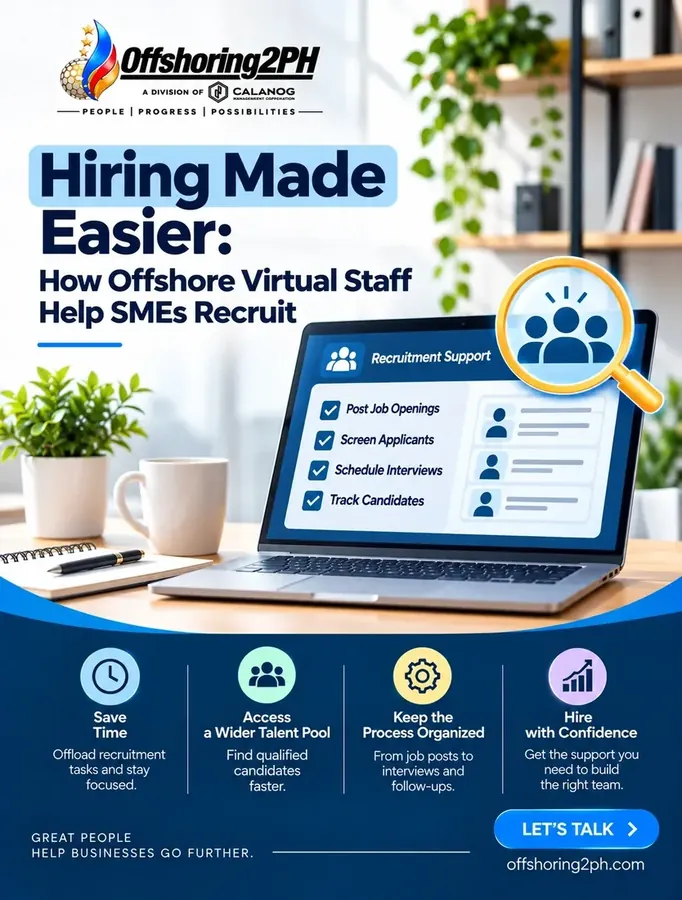
Recruitment slows when calendars, candidate updates and interview logistics compete with the work of running a business. A well-defined offshore support role can bring order to the process without taking hiring decisions away from managers.
October 23, 2026 | Offshoring2PH Editorial
The hiring process has a hidden workload
A founder approves a new position on Monday. By Friday, the job description is still being revised, applications are scattered across inboxes, and the hiring manager has not found time to schedule interviews. The problem is not a lack of interest in hiring. It is that recruiting has become another operational responsibility for a team already at capacity.
For small and medium enterprises (SMEs) and startups, this is a familiar tension. Every new hire matters, yet few growing businesses have a dedicated recruiting operations team. Managers need to assess skills, define the role and make sound hiring decisions. At the same time, someone must keep the process moving: publish approved vacancies, acknowledge applicants, coordinate interviews, update records and follow up on next steps.
Those tasks are not incidental. When they are inconsistent, candidates wait, managers lose visibility and promising applicants can disengage. Offshore virtual staff can help by taking ownership of the repeatable coordination work around hiring, while the business retains control of selection and employment decisions.
Separate recruiting judgment from recruiting administration
The first step is to distinguish tasks that require managerial judgment from tasks that require reliable execution. A hiring manager should still determine the role requirements, evaluate job-related capabilities, conduct substantive interviews, decide who advances and approve any offer. Those decisions are central to accountability.
Administrative support can handle a different set of responsibilities: maintaining the applicant tracker, checking whether required materials have arrived, sending approved scheduling messages, coordinating interview availability, preparing interview packs and recording the next agreed action. With appropriate training, a virtual staff member can also help organize responses to pre-defined, job-related application questions, without independently inventing selection criteria.
This division of labor protects the quality of the hiring process. The manager spends more time evaluating people and less time searching for the latest résumé or sending the third calendar reminder.
Build one visible candidate pipeline
A shared pipeline is more useful than a collection of forwarded emails. It does not have to be an expensive applicant tracking system. A secure, appropriately configured recruiting platform or structured tracker may be sufficient for a small number of openings.
At a minimum, each candidate record should show the role applied for, current stage, responsible decision-maker, most recent contact, next action and its due date. Standard stage names—such as application received, review pending, interview scheduled, decision pending and closed—make the process easier to understand.
An offshore recruiting coordinator can keep these records current and flag stalled applications. The business should still define who is permitted to access candidate information, what may be recorded and when records should be deleted under its applicable privacy requirements.
Make candidate communication predictable
A professional candidate experience is often built from ordinary details: acknowledging an application, giving accurate interview instructions, explaining what happens next and notifying applicants when a process has concluded.
Virtual staff can maintain approved email templates, confirm interview times across time zones, share logistics, send reminders and follow up when a manager has missed an internal decision deadline. They can also flag when a candidate needs an accommodation or a question requires HR review rather than improvising a response.
The aim is not to automate away human contact. It is to make sure routine communication happens consistently so that the moments requiring judgment or empathy receive the attention they deserve.
A practical example: one role, fewer loose ends
Consider a hypothetical 35-person software services company recruiting a customer support specialist and an account coordinator at the same time. The operations manager owns the hiring decisions but is also responsible for client delivery. Applications arrive through two job boards and email; interview invitations are sent manually; candidate status is kept in separate spreadsheets.
Instead of asking a new offshore employee to “manage recruitment,” the company assigns a narrower workflow: consolidate applications in an approved system, check submissions against an established completeness checklist, send approved acknowledgments, coordinate interview slots, and prepare a daily list of decisions needed from the manager.
The manager still reviews qualifications, interviews applicants and makes decisions. The virtual staff member keeps the workflow visible. The likely improvement is not a guaranteed reduction in time-to-hire; it is fewer avoidable handoff delays and a clearer picture of where each opening stands.
Keep fairness and data protection in the design
Hiring support is not a low-risk administrative function simply because it is performed remotely. Applicant records contain personal information, and screening practices can create fairness and legal risks.
Use job-related criteria that are approved before applications are reviewed. Do not let an assistant make ad hoc judgments based on names, photographs, age, family status or other irrelevant personal characteristics. For U.S. employers, the Equal Employment Opportunity Commission warns that selection procedures can raise discrimination concerns even when they appear neutral. Rules vary by jurisdiction, so employers should obtain appropriate local guidance.
Privacy controls matter just as much. Give virtual staff role-based access, require secure authentication, document confidentiality obligations and establish a retention schedule. The Philippine National Privacy Commission emphasizes lawful, proportionate processing and appropriate safeguards when personal information is handled by third parties. A company hiring across borders should confirm which privacy and employment rules apply to its own operations.
Measure progress without rewarding the wrong behavior
Speed is useful, but it is not the only measure of a good hiring process. A coordinator who pushes every candidate forward quickly can create more work for managers. A process that rejects applicants too aggressively can miss capable people.
Start with operational measures that reflect the support role: percentage of candidate records with a current next action, time taken to send approved acknowledgments, interviews scheduled without avoidable rescheduling, overdue internal decisions flagged and completeness of interview documentation.
Then assess the manager’s experience. Is it easier to see the pipeline? Are fewer applications lost between steps? Does the manager spend less time coordinating logistics? Are candidates receiving clearer communication? These measures are more meaningful than counting emails sent.
Use a four-week pilot before expanding the role
Week one should focus on mapping the current process. Identify each stage, the decision owner, recurring messages, systems, privacy requirements and the most common delays. Document a small set of tasks that can be delegated safely.
In week two, introduce the virtual staff member to the approved tools and templates. Have the manager review outbound communication and tracker updates closely. During week three, allow more independent ownership of routine coordination while preserving escalation rules for unusual requests, sensitive information and candidate concerns.
In week four, review the workflow together. Which handoffs improved? Which instructions remained unclear? What still requires management time? Expand the role only after the initial responsibilities are reliable. A small, well-run process is a stronger foundation than an ambitious job description that no one can supervise.
Understand the limits of offshore recruiting support
A remote coordinator cannot repair a poorly defined job, an uncompetitive offer or a manager who takes weeks to make decisions. Offshore support also requires onboarding, quality checks, time-zone planning and clear ownership. For sensitive or regulated roles, background checks, assessment practices and record handling may require specialist oversight.
There is a cost case for delegating repeatable work to Philippines-based professionals, but savings will depend on role complexity, management effort, technology, working hours and the service arrangement. The strongest business case combines sensible cost management with better process reliability and more focused management time.
Turn hiring from an interruption into a repeatable process
For a growing business, recruitment should not stop every time a manager becomes busy. Clear stages, consistent communication and dependable coordination help the company maintain momentum without lowering its standards.
Offshoring2PH works with SMEs and startups to build Philippines-based teams, including virtual assistance and administrative support, with recruitment and ongoing operational support through its co-managed staffing model. If interview scheduling, candidate tracking and follow-ups are consuming time your managers need elsewhere, start by mapping those tasks and defining the outcomes a dedicated virtual staff member could own.
The next hire should not create another layer of chaos. With the right support structure, it can help your business build a hiring process that is easier to run—and easier to improve.