
OFFSHORING2PH INSIGHTS
Smarter Vendor Management With Offshore Staff
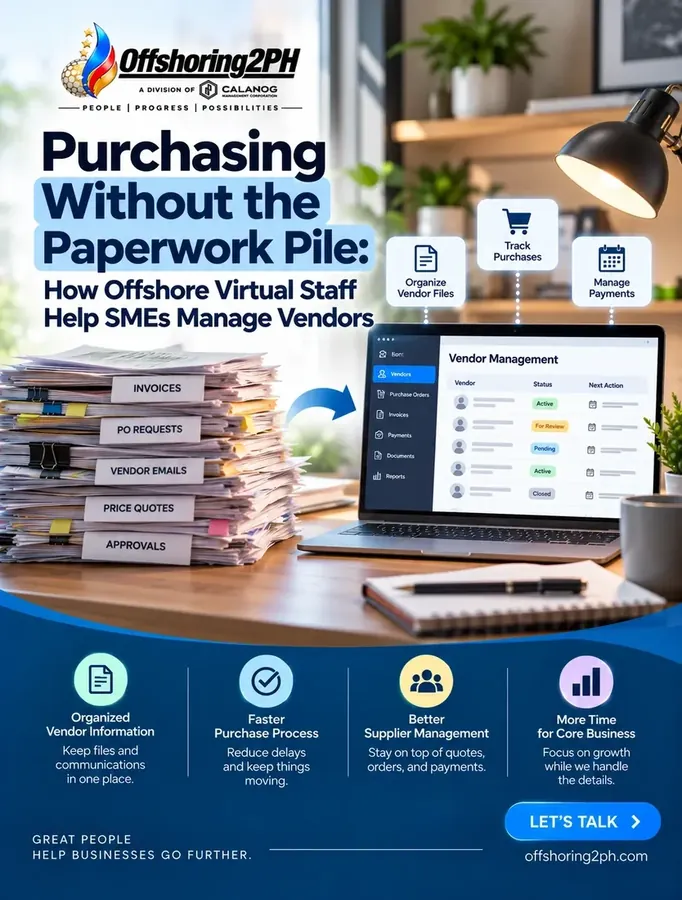
Growing companies do not need a full procurement department to improve purchasing discipline. They need clear ownership of vendor records, purchase requests, renewals, and documentation—and a staffing model that keeps approvals where they belong.
The purchasing problem that rarely looks urgent
A supplier quote is buried in an email thread. A software subscription renews before anyone reviews whether the team still uses it. An invoice arrives without a purchase order, and the finance manager has to reconstruct who requested the service. A vendor changes its contact details, but the update never reaches the shared records.
Individually, these issues can seem minor. Together, they create a purchasing process that relies on memory, interruptions, and last-minute decisions. For small and medium enterprises (SMEs) and startups, the problem often appears well before there is enough purchasing volume to justify a dedicated procurement department.
This is where offshore virtual staff can add value—not by making spending decisions for the business, but by taking ownership of the repeatable administrative work that helps those decisions happen with better information.
Why vendor administration becomes a growth constraint
In a very small company, one founder or operations manager may know every supplier. Growth changes that. Teams add software subscriptions, contractors, office services, logistics providers, equipment suppliers, and specialist vendors. Each relationship brings records, renewal dates, quotes, delivery updates, and payment terms.
When those details are scattered across inboxes and spreadsheets, employees spend time locating information rather than evaluating it. Managers may approve requests without seeing comparable options or an accurate history of previous orders. Finance teams may receive incomplete documentation after the purchase has already happened.
The solution is not necessarily more bureaucracy. It is a lighter, more reliable administrative process that makes purchasing activity visible.
What an offshore purchasing-support role can actually own
A Philippines-based virtual assistant or operations support professional can be trained to maintain a central vendor directory, collect quotations, organize purchase requests, prepare draft purchase orders, monitor order status, record contract and subscription renewal dates, and assemble documents for finance review.
The role can also coordinate routine supplier communications, follow up on missing delivery confirmations, and flag discrepancies between an approved order and the invoice received. These activities are particularly suitable for remote work when the business uses shared purchasing, accounting, and document-management systems.
The boundaries matter. The employee should not be given unilateral authority to select suppliers, change vendor bank details, approve purchases, or release payments merely because they manage the paperwork. Those decisions require the company’s own authorization rules.
Build a simple purchasing workflow before hiring
Before recruiting, trace one purchase from request to payment. Who asks for the product or service? Who approves the spend? Who collects the quote? Who confirms that the goods or service arrived? Who reviews the invoice? Who authorizes payment?
Write down the steps, even if the company uses only a shared tracker and its existing accounting software. Then identify where work is delayed or repeatedly handed back because information is missing.
For example, a virtual staff member might receive an approved request, obtain supplier quotations according to company rules, enter the comparison into a standard template, prepare an order for manager approval, and update its status after the supplier confirms. The manager still decides whether to proceed. The finance team still controls payment.
This division of labor is useful because it separates preparation and follow-through from authority.
Treat vendor records as operational infrastructure
A vendor list should be more than names and email addresses. Depending on the business, useful fields may include the vendor’s approved legal name, service category, internal owner, contract location, renewal date, payment terms, tax documentation status, and last review date.
Keep sensitive banking information in appropriately restricted systems rather than general-purpose trackers. Changes to payment details should go through a separate verification and approval process, not simply an emailed request.
A virtual staff member can maintain the non-sensitive directory, request missing documents, flag approaching renewals, and make sure the appropriate manager has the information needed for review. Better records do not automatically reduce spending, but they make waste, duplication, and missed decisions easier to spot.
Make internal controls part of the role design
Purchasing support is useful only when it preserves accountability. Guidance from the University of California, Davis emphasizes separating buying functions so one individual does not control all stages of a purchase. In practice, an SME should distinguish among requesting, approving, receiving, recording, and paying—even if some of those checks are performed through documented manager review.
This is especially important in a lean team, where the same few people may touch multiple steps. A virtual employee can prepare documents and track exceptions, while authorized local personnel approve suppliers, verify receipt, and release funds. Access permissions should reflect those responsibilities.
The principle is straightforward: outsource administrative execution, not financial control.
The measurable benefits are practical, not magical
An offshore purchasing-support role may help reduce time spent chasing quotations, improve the completeness of purchase records, make upcoming renewals more visible, and free managers from routine status updates. Offshore staffing may also provide a cost-efficient way to establish dedicated administrative capacity before hiring a full local procurement team.
But results depend on purchasing volume, process maturity, training, system access, and management oversight. A business with only a handful of purchases each month may not need a dedicated role; the work could fit within a broader operations or executive-assistance position.
It is also worth comparing the cost of staffing with process simplification and software automation. If a task can be eliminated or handled reliably by an existing system, adding a person should not be the default response.
A 30-day pilot for SMEs and startups
In week one, identify the most common purchasing bottlenecks and collect a baseline: missing purchase documentation, time to obtain quotations, unreviewed renewals, and manager time spent following up. Choose one narrow workflow rather than transferring all vendor activity at once.
In week two, document the process, define approval limits, set up role-based access, and provide sample records. During weeks three and four, assign the offshore employee responsibility for tracking and preparation while managers review the output and handle exceptions.
At the end of the month, ask whether records are more complete, requests move with fewer reminders, and managers have better visibility. Extend the pilot only if the quality of work and control environment justify it.
When to consider offshore vendor-management support
This type of role is worth evaluating when supplier information is scattered, managers repeatedly chase routine purchasing updates, software renewals go unreviewed, or finance frequently receives incomplete order documentation.
It can also make sense when the company has grown beyond founder-managed purchasing but does not yet need a specialist procurement manager. The best candidate is a repeatable, document-heavy workflow with clear ownership and well-defined approval points.
For businesses purchasing highly regulated products, managing complex contracts, or negotiating strategic supplier agreements, administrative support should complement—not replace—qualified procurement, legal, or finance professionals.
Make purchasing easier to manage with Offshoring2PH
Offshoring2PH helps growing businesses build Philippines-based teams with recruitment, HR, and operational support. Its virtual-assistance and accounting service areas can provide a starting point for discussing the administrative skills a business needs; the exact purchasing-support scope should be defined during role planning.
If your team is spending too much time collecting quotes, locating supplier records, and tracking routine purchasing tasks, start with a review of that workflow. A well-scoped offshore virtual staff role can help keep the process organized while your managers retain the authority to make the decisions that matter.