
OFFSHORING2PH INSIGHTS
The 1st Five Roles a Growing Business Should Consider Offshoring
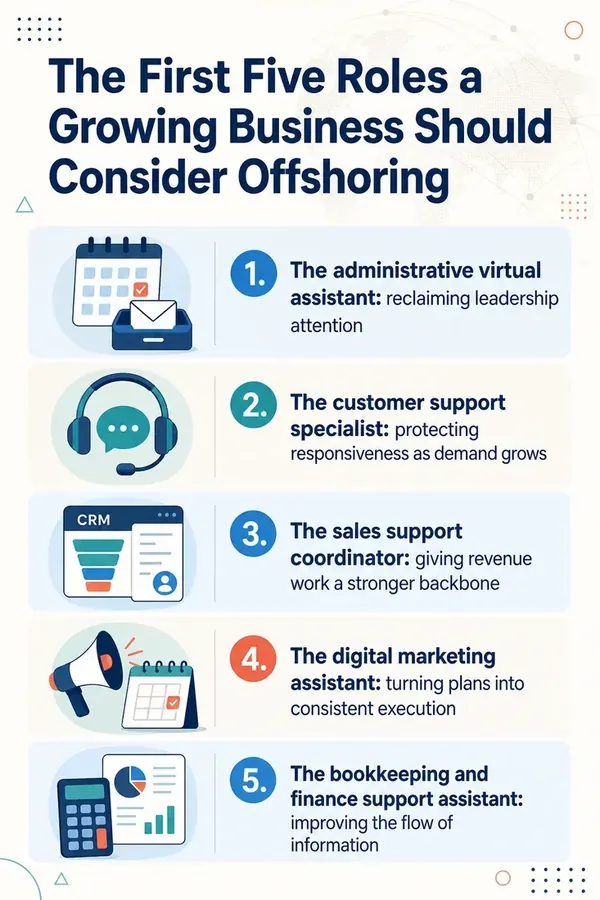
A practical guide for SMEs and startups | August 31, 2026
Growth rarely arrives in a tidy sequence. A startup wins a new account before its operating systems are ready. An established small business adds a product line, then discovers that its senior people are spending their best hours updating spreadsheets, chasing documents, and clearing crowded inboxes. The opportunity is welcome; the operational drag is not.
This is where offshore staffing deserves a more thoughtful place in the growth conversation. It is not simply a way to move tasks elsewhere. Done well, it is a way to build dependable capacity around work that matters but does not always need to sit with an expensive local specialist or founder.
The sensible question is not, “What can we send offshore?” It is, “Which role would remove the most friction from the business while remaining clear, measurable, and coachable?” For many small-to-medium enterprises and startups, five role families consistently provide a useful starting point.
1. The administrative virtual assistant: reclaiming leadership attention
The first constraint in a growing company is often not capital or demand. It is attention. Founders and managers become the routing layer for calendars, meeting preparation, travel research, document organization, inbox triage, data entry, and a dozen small follow-ups. None of these duties is trivial; together, however, they can consume the hours needed for sales, strategy, hiring, and customer relationships.
A virtual administrative assistant can create a dependable operating rhythm. The role might prepare agendas, maintain action lists, organize shared files, update internal trackers, coordinate appointments, and make sure routine requests reach the right person. The value comes less from completing isolated errands than from reducing the number of open loops carried by senior staff.
This role is a strong first offshore hire when the work is frequent, process-driven, and easy to review. Success can be defined through practical measures: response times, calendar accuracy, completion rates, and the number of recurring tasks transferred from leadership.
2. The customer support specialist: protecting responsiveness as demand grows
Customer experience can deteriorate quietly. A business adds customers, but its response capacity remains unchanged. Emails wait longer. Basic questions interrupt technical staff. Complaints reach decision-makers only after frustration has built. The company may still be growing, yet each delayed reply weakens trust.
An offshore customer support specialist can handle a defined first line of service: answering common questions, logging issues, updating customers, processing straightforward requests, and escalating cases according to clear rules. For startups and SMEs, this helps preserve a human, responsive experience without requiring every inquiry to land on a founder or senior operator.
The key is scope. A support specialist should know what they may resolve, what needs approval, and what must be escalated immediately. A well-maintained knowledge base, approved response guidelines, and a short quality-review loop are more valuable than a thick manual nobody uses. When those foundations are in place, offshore support can extend capacity while keeping accountability visible.
3. The sales support coordinator: giving revenue work a stronger backbone
Salespeople are most valuable when they are speaking with prospects, understanding needs, shaping proposals, and advancing decisions. Yet in many smaller firms, a surprising portion of the sales week disappears into contact research, CRM updates, list cleaning, meeting scheduling, proposal formatting, and follow-up administration.
An offshore sales support coordinator can take ownership of this operational layer. The role can prepare prospect information, maintain records, organize collateral, monitor follow-up dates, and make sure promising conversations do not vanish into an untidy pipeline. This is not a substitute for relationship-led selling. It is the infrastructure that allows relationship-led selling to happen more consistently.
This position works best when the business already has a defined audience, a clear offer, and an agreed sales process. If the strategy changes every week, an offshore coordinator will inherit confusion. If the process is reasonably stable, the coordinator can improve discipline and free revenue leaders to concentrate on judgment-heavy work.
4. The bookkeeping and finance support assistant: improving the flow of information
Small businesses do not usually struggle because they lack financial data. They struggle because the data arrives late, is stored inconsistently, or requires too much manual effort before it becomes useful. Receipts need organizing. Invoices need tracking. Records need updating. Reports need preparation for review by the appropriate finance professional.
A finance support assistant can help maintain the administrative side of that workflow: collecting and categorizing documents, updating approved systems, tracking outstanding items, preparing routine summaries, and flagging discrepancies for review. The aim is not to transfer professional accountability. It is to ensure that the people who hold that accountability receive cleaner, timelier information.
Because financial work is sensitive, this role requires disciplined access controls, documented approval boundaries, and regular review. Start with a narrow set of repeatable activities. Use role-based permissions. Keep final approvals with authorized personnel. With these safeguards, offshore finance support can reduce backlogs and make the monthly operating picture easier to see.
5. The digital marketing assistant: turning plans into consistent execution
Marketing inconsistency is a familiar symptom of a stretched team. The business has ideas, expertise, and perhaps even a content plan, but publishing slips whenever client work becomes urgent. Social posts are delayed. Website updates remain on the list. Campaign data is collected but not organized. The brand appears active in bursts rather than through a steady presence.
An offshore digital marketing assistant can support the execution engine: scheduling approved content, formatting articles, preparing simple creative variations, maintaining content calendars, conducting structured research, updating web pages, and compiling performance information. Strategic direction and final approval can remain with internal leaders or specialist partners, while the assistant keeps the production rhythm moving.
This role is particularly useful when the bottleneck is no longer ideas but follow-through. Give the assistant a clear brand guide, examples of acceptable work, an approval path, and a realistic publishing cadence. Consistency then becomes a managed process rather than a recurring act of rescue.
How to choose the right first offshore role
A fashionable job title is a poor basis for a staffing decision. Begin with the work itself. For two weeks, ask key team members to note recurring tasks that consume time, follow a recognizable process, and do not require their highest level of judgment. Then group those tasks into a coherent role rather than assembling an arbitrary collection of leftovers.
A promising first offshore role usually has four characteristics: the work recurs often enough to justify ownership; the expected output can be described; performance can be reviewed without constant surveillance; and the role creates meaningful time or service capacity for the existing team.
Avoid designing the position around every task nobody wants. A strong role has a purpose. “Keep customer requests moving and accurately documented” is a purpose. “Do whatever comes up” is not. Clarity improves recruitment, onboarding, motivation, and management on both sides.
Build the system before expecting scale
The quality of an offshore hire depends partly on the person and partly on the environment the business creates around them. Before the first day, identify the role’s core outcomes, the systems the employee will use, the decisions they may make, and the situations that require escalation. Record short demonstrations of essential workflows and provide examples of completed work.
During the first month, use regular check-ins to answer questions and refine the process. Review outputs against agreed standards, not against unspoken preferences. As confidence grows, move from task-by-task instruction toward ownership of outcomes. That progression is where a virtual staff member begins to feel like part of the operating team rather than an external pair of hands.
Security and continuity should be designed in from the beginning. Provide only the access needed for the role, use company-managed accounts where practical, document critical processes, and remove permissions promptly when responsibilities change. These are good operating habits for every distributed team, not special burdens created by offshoring.
The strategic benefit: capacity without unnecessary complexity
For an SME or startup, the attraction of offshoring is not merely the possibility of controlling employment costs. The larger benefit is organizational leverage. When repeatable work has a clear owner, local specialists can focus on decisions, relationships, innovation, and market knowledge. Customers receive more consistent attention. Important routines continue even when the founder is occupied elsewhere.
The best first role is therefore the one that changes how the rest of the team spends its time. It should relieve a real constraint, strengthen a visible workflow, and create a foundation for further growth. Start with one well-designed position, learn how to manage it, and expand only when the operating case is clear.
Offshoring2PH can help businesses explore how virtual staff may fit into that next stage of growth. If your team is carrying recurring work that deserves a dedicated owner, begin by identifying the role, outcomes, and working rhythm that would make the greatest difference. A focused conversation today can become the capacity your business needs tomorrow.