
OFFSHORING2PH INSIGHTS
The Management Bandwidth Problem: How Offshore Virtual Staff Help
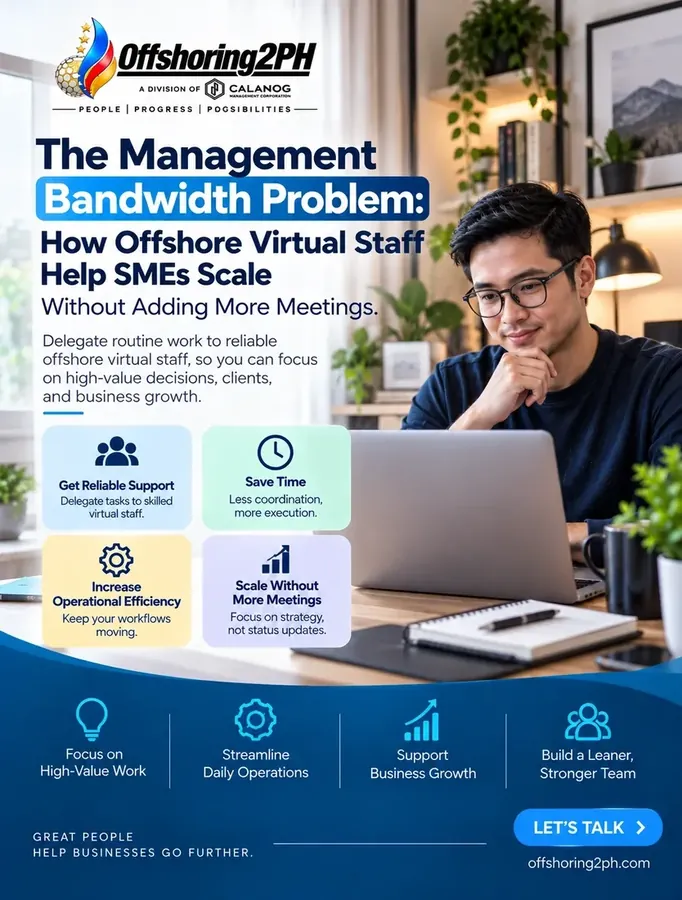
Growth creates more than additional work. It creates more coordination. For SMEs and startups, offshore virtual staff can help absorb recurring execution and reporting so managers can spend less time chasing tasks and more time making decisions.
October 2, 2026 | Offshore Staffing Strategy
Growth can consume management before it consumes budget
Most growing businesses eventually encounter a constraint that does not appear clearly on a profit-and-loss statement: management bandwidth.
As customers, employees, suppliers, projects, and sales opportunities increase, so does the amount of coordination required to keep them moving. Managers spend more time checking status, requesting updates, preparing recurring reports, organizing meetings, correcting records, and reminding people about next actions.
At first, these activities feel like a normal part of leadership. Over time, they can crowd out the work managers are actually there to do: make decisions, coach employees, improve systems, develop customers, and allocate resources.
For small and medium enterprises and startups, the answer is not necessarily another layer of management. Sometimes the more useful investment is a reliable layer of execution.
The hidden cost of coordination work
Coordination tasks are rarely difficult enough to justify senior expertise, but they are important enough that ignoring them creates operational friction.
Consider a sales manager who spends part of every morning checking whether CRM records are current. An operations leader may repeatedly gather updates before a weekly meeting. A founder may personally coordinate calendars, prepare documents, and follow up on routine actions because nobody else clearly owns them.
The direct cost is the manager's time. The larger cost is what that time displaces. Every hour spent reconstructing status is an hour not spent improving the sales process, solving a customer issue, reviewing financial performance, or planning the next stage of growth.
Offshore virtual staff can create an execution layer
A well-designed offshore role can sit between management decisions and routine execution.
An executive or operations assistant can maintain action trackers, coordinate schedules, prepare meeting materials, organize documentation, and follow up on agreed tasks. A sales-support professional can maintain CRM data, prepare prospect research, organize pipeline information, and coordinate next steps. A finance-support employee can prepare recurring schedules, organize transaction documentation, and assist with defined bookkeeping workflows under appropriate supervision.
The purpose is not to transfer management responsibility offshore. It is to reduce the amount of administrative coordination managers must personally perform.
The best tasks to delegate are predictable but persistent
Start by looking for work that returns every day or every week. These tasks often create the greatest cumulative burden.
Examples include updating systems, preparing recurring reports, maintaining trackers, coordinating calendars, organizing meeting agendas, documenting action items, researching prospects, processing standard requests, preparing routine customer communications, and following up on agreed deadlines.
A useful test is simple: if the task disappeared from a manager's calendar tomorrow, would the manager have more time for work that genuinely requires their judgment? If the answer is yes, the task deserves closer examination.
Do not delegate ambiguity
Delegation fails when businesses transfer a problem without defining the expected outcome. An instruction such as “keep everything organized” gives an employee responsibility without enough structure to succeed.
Define what the employee owns, what completed work looks like, which systems should be used, how frequently the task occurs, and when an exception should be escalated.
For example, an offshore operations assistant might own the weekly action tracker. Every open item must show an owner, deadline, current status, and next action. Overdue items are flagged before the management meeting. The assistant maintains the information; managers remain responsible for decisions and accountability.
That distinction turns vague assistance into an operating role.
Replace status meetings with visible information where possible
One of the most valuable outcomes of stronger administrative support is fewer meetings devoted solely to discovering what is happening.
If an offshore employee maintains accurate trackers, CRM records, project updates, or reporting dashboards, managers can review information before a meeting. The conversation can then focus on exceptions, decisions, and priorities rather than collecting updates from scratch.
Not every meeting should disappear. Complex work still benefits from discussion. But businesses should distinguish meetings that create decisions from meetings that compensate for missing information.
Create a clear escalation ladder
Virtual staff become more effective when they know what they can handle independently and when management involvement is required.
Routine scheduling, approved communications, data maintenance, standard reporting, and documented administrative workflows may require little intervention once the employee is trained. Pricing changes, contractual commitments, unusual customer complaints, regulated decisions, or significant exceptions may need escalation.
Write these boundaries down. Clear escalation rules reduce unnecessary interruptions while protecting decisions that should remain with experienced employees.
Measure management time recovered
Businesses often evaluate offshore staffing by comparing salaries. Cost matters, but management capacity provides another useful measure.
Before introducing the role, estimate how much time managers spend each week on the responsibilities being delegated. After the employee has completed an appropriate onboarding period, measure again.
Then look beyond hours. Are managers entering meetings better prepared? Are fewer tasks being chased manually? Are records more current? Are recurring reports arriving on time? Are managers able to spend more time on customers, employees, planning, or process improvement?
These indicators help determine whether the role is improving the way the business operates.
Expect an initial investment in onboarding
An offshore hire does not create management capacity immediately. During the first weeks, the business will need to invest time in training, documentation, system access, examples, feedback, and relationship building.
That investment should be planned rather than treated as evidence that delegation is not working. The goal is to move from frequent instruction toward reliable ownership as the employee learns the role.
Businesses should also apply appropriate information-security controls, including role-based access, individual accounts where practical, multi-factor authentication, and procedures for confidential information. Regulated activities may require additional professional or legal guidance.
Use the first hire to improve the operating system
The process of onboarding an offshore employee often reveals weaknesses that existed before the hire: unclear ownership, inconsistent procedures, undocumented exceptions, duplicate spreadsheets, or meetings with no defined purpose.
Treat those discoveries as useful information. Simplify workflows, remove unnecessary steps, document recurring decisions, and establish one reliable location for operational information.
The result can be more valuable than delegation alone. The business begins to replace institutional memory with repeatable processes.
Scale management capacity before adding management layers
Growing SMEs eventually need additional leaders. Offshore staffing is not a substitute for management expertise when the business genuinely requires it.
But before adding another management position, it is worth asking whether current managers are overloaded because the organization lacks leadership—or because too much recurring execution still sits on their desks.
Offshoring2PH helps SMEs and startups explore Philippines-based virtual staffing for defined support functions, including administration, customer support, sales support, accounting and bookkeeping support, and other remote-capable workflows.
If your managers are spending more time coordinating work than improving it, start by identifying the recurring tasks consuming their week. The right virtual staff role can give those tasks a clear owner—and give management some of its attention back.
SEO publishing notes
Suggested meta title: How Offshore Virtual Staff Increase Management Capacity for SMEs
Suggested meta description: Learn how SMEs and startups can use offshore virtual staff to reduce coordination work, recover management time, and build more scalable operations.
Primary keyword: offshore virtual staff for SMEs
Secondary keywords: virtual staff Philippines, offshore outsourcing for startups, executive virtual assistant, offshore administrative support, SME outsourcing
Suggested URL slug: offshore-virtual-staff-management-bandwidth-smes