OFFSHORING2PH INSIGHTS
Turning Customer Feedback Into Business Growth
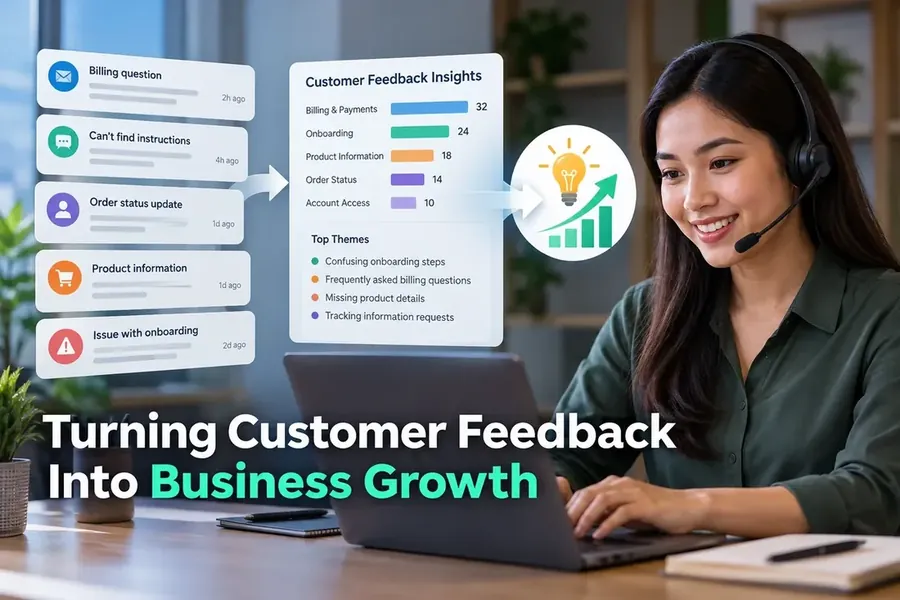
For growing SMEs and startups, customer inquiries are more than requests to resolve. They are a recurring source of insight about confusing processes, product friction and preventable service problems. The right offshore support role can help make that insight visible—without turning managers into full-time ticket analysts.
21 October 2026 • Offshore staffing strategy • SMEs and startups
A growing inbox can hide a growing business problem
A customer asks the same billing question for the third time this month. Another cannot find the correct onboarding instructions. A prospective buyer abandons a purchase because a product detail is unclear. Each issue is handled, the ticket is closed and the team moves on.
Individually, these are ordinary service interactions. Together, they may reveal an expensive pattern: customers repeatedly encounter the same friction, while the business treats every incident as a new problem.
This is the customer feedback blind spot. Many small and medium enterprises collect a surprising amount of customer information through email, chat, phone calls and help desks, yet have no reliable process for converting those conversations into operational improvements.
Offshore virtual staff can help close that gap. When a customer support or operations role is designed to capture recurring issues—not merely clear the queue—the business gains both execution capacity and a clearer view of what customers are experiencing.
Support volume is not the same as support intelligence
Most businesses track what is easiest to count: open tickets, response times and cases resolved. These measures are useful for managing a queue, but they do not fully explain why customers need assistance in the first place.
A team might meet its response-time target while answering the same avoidable question dozens of times. A founder might see a stable ticket count without realizing that one confusing workflow is generating disproportionate effort. A sales manager might hear about objections only when a deal is already lost.
The opportunity is to look one level deeper. Which issues recur? Which ones require multiple contacts? Which handoffs create confusion? Which questions could be answered with clearer instructions, better account information or a small change in the process?
Those are questions a well-trained offshore support professional can help document consistently, giving managers evidence to review rather than anecdotes to remember.
Give the offshore role two jobs: resolve and record
A useful support workflow has two distinct responsibilities. First, respond to customers accurately and within the agreed scope. Second, capture enough structured information for the company to identify recurring themes.
That second responsibility does not need to be complicated. A short set of issue categories may be enough: billing and payments, account access, order status, product information, onboarding, technical difficulty and other. Add a field for whether the case was resolved at first contact and whether a product, policy or process change might prevent a repeat.
For a B2B software startup, repeated setup questions may indicate an onboarding gap. For a professional services firm, recurring requests for status updates may signal weak client communication. For an ecommerce business, frequent delivery inquiries may point to missing tracking information rather than inadequate customer service.
The offshore employee should not be expected to diagnose the entire business. Their contribution is to apply consistent categories, preserve the customer context and surface patterns for the people who own the decisions.
Make the weekly insight report short enough to use
A common mistake is to create a reporting process so elaborate that nobody reads it. An effective weekly support summary can fit on one page.
It might show the most common contact reasons, a few representative examples with identifying details removed, the number of unresolved or repeatedly reopened cases, changes from the prior period and two or three issues that need management attention.
The summary should distinguish observation from recommendation. “Customers contacted support 18 times about the invoice portal” is an observation. “Rewrite the invoice instructions” is a possible response that management should evaluate.
For smaller teams, trends matter more than impressive-looking dashboards. A recurring issue identified early can be more actionable than a large collection of charts produced after the fact.
Build a clear escalation path before expanding coverage
An offshore support employee can handle routine questions, document requests, update records and route exceptions when the company provides clear policies and approved responses. But not every customer interaction should be resolved independently.
Define the boundaries for refunds, discounts, contract changes, security incidents, disputed charges, legal concerns, complaints involving sensitive personal information and unusual technical problems. State who can approve an exception, how quickly it must be escalated and what information should accompany it.
This protects the customer and the business. It also prevents a well-intentioned employee from improvising a policy that management never approved.
Where customer data is involved, use individual accounts, least-privilege access, multi-factor authentication and appropriate retention rules. Sensitive information should not be copied into informal spreadsheets or shared channels simply to make reporting easier.
A practical 30-day rollout
The first week is for mapping the work. Review recent support conversations, choose a small number of issue categories and document the standard responses and escalation rules. Identify the system of record so that notes do not become scattered across inboxes and spreadsheets.
In the second week, train the offshore employee using real but appropriately protected examples. Review how the same issue should be tagged, what counts as a resolved case and when a manager must intervene. Calibrate quality before increasing the volume of independent work.
In the third week, begin a simple weekly summary. Ask the employee to flag repeated questions, unclear instructions and cases that required more than one handoff. Managers should review the findings and choose one or two improvements to test.
In the fourth week, check whether those improvements changed the customer experience. Did the updated help article reduce a common question? Did a clearer email template prevent repeated follow-ups? Did a revised handoff make ownership easier to understand?
The objective is not to prove a dramatic return in 30 days. It is to establish a repeatable feedback loop: capture, review, improve and check again.
Measure outcomes that reflect the customer experience
Response time and ticket volume still matter, but they should be interpreted alongside quality. A fast response that fails to resolve the issue can create more work for everyone.
Useful measures may include first-contact resolution, repeat contacts for the same issue, reopen rates, quality-review findings, backlog age, escalation accuracy and the number of recurring issues with an assigned improvement owner.
A small business should avoid using any one metric as a verdict on the employee. A temporary increase in escalations, for example, may reflect better identification of exceptions rather than weaker performance. Customer feedback and periodic case reviews provide necessary context.
Most importantly, measure whether the insights lead to decisions. A list of recurring problems has limited value if no one is responsible for acting on it.
The economics go beyond lower staffing costs
Philippines-based virtual staffing may offer a cost advantage compared with hiring the same role in some higher-cost markets. Yet the business case should include recruitment, onboarding, supervision, software, training and quality assurance—not just the hourly rate.
The additional value comes from allocating work more effectively. A dedicated support professional can manage repeatable interactions and keep records current, while product owners, account managers and founders concentrate on decisions that require their expertise.
There is also a less obvious benefit: when the team consistently identifies the causes of repeat inquiries, the company has a better opportunity to remove avoidable work. That outcome is not automatic. It depends on management acting on the information and checking whether the change helped.
When this model is—and is not—a good fit
This approach works best when the company has a steady flow of digitally manageable customer interactions, an accessible system for recording them, a defined service scope and someone internally who can review patterns and approve changes.
It is less suitable as a quick fix for an undefined product, unresolved policy disputes or a customer experience that requires specialist judgment on nearly every interaction. If the underlying process is chaotic, an offshore hire will need structured onboarding and active management before they can add consistent value.
Start with a narrow role, clear ownership and realistic service expectations. Expand the scope only after the employee can handle the current workflow accurately.
Turn everyday conversations into better operations
For SMEs and startups, customer support is often treated as a cost to control. It is also one of the most direct ways to see where the business makes customers work harder than they should.
The right offshore virtual staff role can help maintain that visibility. By responding to routine inquiries, documenting common issues, preparing concise reports and escalating exceptions, a support professional can give management a more reliable basis for improving the customer experience.
Offshoring2PH helps growing businesses build Philippines-based teams for customer service, virtual assistance and other defined support functions, with recruitment and ongoing operational support. If your team is spending time answering the same questions without learning from them, discuss the workflow with Offshoring2PH. A well-scoped offshore role may help you handle today’s inquiries while identifying the changes that could prevent tomorrow’s.