
OFFSHORING2PH INSIGHTS
Why SMEs and Startups Are Building Leaner Teams Through Offshore
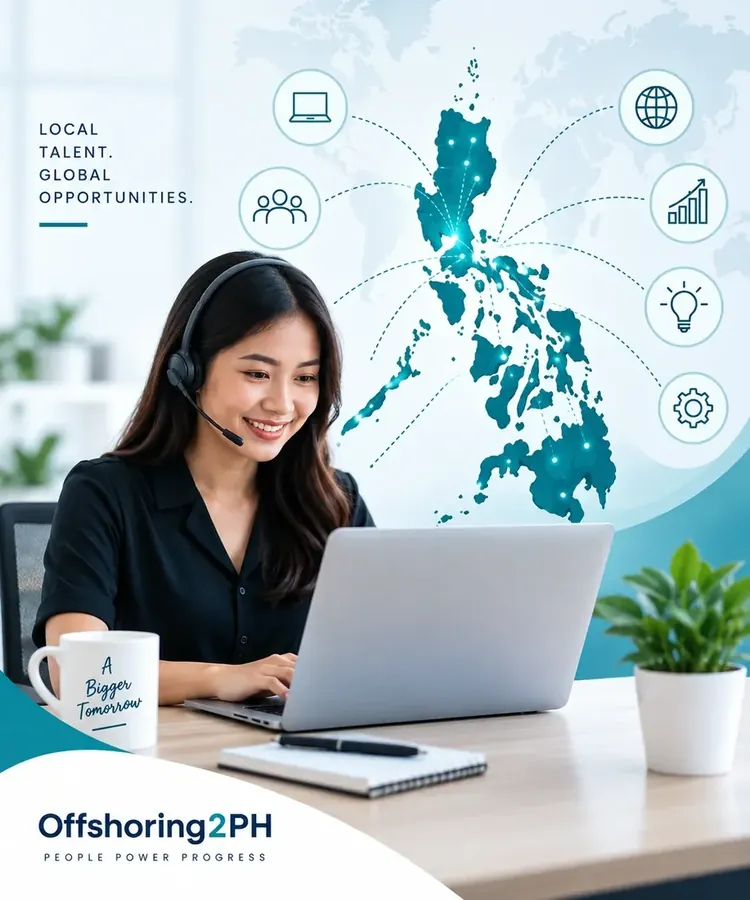
A practical look at how offshore staffing can expand capability, protect focus, and support sustainable growth.
September 9, 2026 | Offshoring & Growth
Growth creates a staffing problem before it creates a hiring solution
For many small and medium enterprises and startups, growth arrives with an uncomfortable contradiction: there is more work to do, but not always enough budget, time, or management capacity to build a large local team.
Founders and managers often respond by absorbing the extra workload themselves. Sales leaders update CRM records after hours. Operations managers spend mornings preparing reports instead of improving processes. Business owners handle inboxes, scheduling, research, customer follow-ups, bookkeeping support, and other recurring tasks that are necessary but do not always require their direct involvement.
That approach may work temporarily. As a long-term operating model, however, it can become expensive in a different way: senior people spend valuable hours on work that could be delegated, strategic projects move more slowly, and the business becomes dependent on a few overloaded individuals.
This is one reason offshore virtual staffing has become a practical workforce option for growing companies. Used well, it is not simply a way to reduce labor costs. It is a way to redesign who does what inside the business.
Offshoring is most useful when it creates capacity
The strongest business case for offshore staffing begins with capacity. An SME does not necessarily need more employees in every department; it needs the right people handling the right level of work.
A capable offshore virtual staff member can take ownership of defined, repeatable responsibilities such as administrative support, customer service, lead research, CRM maintenance, appointment setting, data entry, bookkeeping support, digital marketing assistance, content operations, e-commerce administration, or back-office coordination.
When those responsibilities are transferred thoughtfully, local employees and founders can concentrate on work that depends on their market knowledge, relationships, judgment, or leadership. The benefit is therefore measured not only in payroll. It can also be measured in recovered management time and increased organizational bandwidth.
The economics can make specialist support accessible earlier
Startups and smaller businesses frequently postpone hiring because a full local salary, recruitment expense, office requirements, equipment, and employment overhead can make each new role a significant commitment.
Offshore staffing can change that calculation. Businesses may be able to access experienced professionals in the Philippines at a cost structure that is more manageable than adding an equivalent role in higher-cost labor markets. That can allow a growing company to introduce dedicated support earlier instead of waiting until workload becomes unmanageable.
Cost, however, should not be the only selection criterion. The cheapest candidate is rarely the best staffing strategy. Communication ability, relevant experience, reliability, role fit, processes, supervision, security practices, and performance expectations all matter. Sustainable offshoring is built around value and capability, not a race to the lowest hourly rate.
Virtual staff can give small companies the operating discipline of larger teams
One overlooked advantage of adding offshore staff is that delegation forces a business to clarify its processes. If a task has always existed only in the founder's head, handing it to another person requires the company to define the workflow, expected output, tools, deadlines, and escalation points.
That discipline is useful. Documented procedures make training easier, reduce dependence on individual employees, and create a clearer foundation for future hiring. A virtual staff member who owns a recurring process can also help turn an informal activity into a consistent business function.
For a startup, this can mean moving from 'someone checks the inbox when there is time' to a defined customer-response workflow. For an SME, it might mean replacing irregular prospect research with a maintained lead database and a consistent sales-support routine. The offshore hire becomes part of a more mature operating system.
Where offshore staffing works particularly well
The best starting roles usually have clear outputs, recurring demand, measurable service expectations, and work that can be performed securely through digital systems.
Administrative and executive support can remove scheduling, inbox, document, research, and coordination work from senior employees. Sales support can improve database hygiene, prospect research, follow-up preparation, and appointment coordination. Customer-service staff can help businesses respond more consistently across email, chat, and support systems. Marketing support can assist with content publishing, campaign administration, reporting, design coordination, and database management. Finance and operations teams can delegate appropriate bookkeeping support, reconciliation preparation, data processing, and reporting tasks subject to suitable controls.
The common factor is not the job title. It is whether the company can define the responsibility clearly enough for another capable person to own it.
What SMEs should put in place before hiring offshore
Offshore staffing performs best when the business treats the virtual employee as part of the team rather than as an anonymous task resource. A clear job description is only the beginning.
Before recruitment, identify the outcomes the role should own, the systems the employee will use, the hours or overlap required, who will manage the person, and how performance will be reviewed. Prepare basic standard operating procedures for critical tasks. Decide what information the employee genuinely needs and apply sensible access controls. Establish a regular communication rhythm, particularly during onboarding.
Most importantly, give the new team member enough context to exercise judgment. Employees perform better when they understand why a task matters, who depends on their work, and what a good result looks like.
The Philippines remains a natural fit for virtual staffing
The Philippines has a long-established business process outsourcing sector and a large workforce accustomed to supporting international organizations. English proficiency, familiarity with Western business practices, and experience across customer service, administration, finance support, sales support, technology, and digital operations have made Filipino professionals a familiar choice for overseas employers.
For SMEs and startups, the opportunity is to apply that talent model at a smaller scale: not necessarily by building a large offshore department, but by adding one or several carefully selected professionals to remove bottlenecks and strengthen specific functions.
Start with the bottleneck, not the headcount target
A useful offshoring conversation begins with a simple question: where is valuable time being spent on work that someone else could competently own?
Review the recurring tasks occupying founders, managers, and higher-cost local employees. Look for responsibilities that are important, process-driven, and consuming enough time to justify dedicated ownership. Then define the role around the business outcome rather than assembling a miscellaneous list of unwanted tasks.
For many companies, the first offshore hire does not need to transform the entire organization. It needs to solve one persistent capacity problem reliably. Once the model works, the company can expand it deliberately.
A more flexible route to building the team you need
SMEs and startups compete with larger organizations while operating with fewer resources. That makes workforce design especially important. Offshore virtual staffing gives growing businesses another way to build capability without assuming that every function must be staffed locally from day one.
Offshoring2PH helps businesses explore virtual staffing in the Philippines and identify professionals suited to the roles they need to fill. If your team is stretched by recurring administrative, sales-support, customer-service, marketing, finance-support, or operational work, the right starting point is to identify what should be delegated and what success should look like.
Talk to Offshoring2PH about the roles slowing your team down today and the virtual staff capabilities that could help you create room for growth.
EDITOR / SEO NOTES
Suggested meta description: Discover how SMEs and startups can use offshore virtual staffing to increase capacity, control hiring costs, improve processes, and keep local teams focused on growth.
Suggested keywords: offshore outsourcing, offshore virtual staff, virtual staffing Philippines, outsourcing for SMEs, outsourcing for startups, Filipino virtual staff